Model by work weight, cache by gap: two rules that save tokens

The two most common wasteful habits with many AI agents: every task gets the biggest model, and prompt caching is set to one hour for everything. I tested both and turned each into a rule.
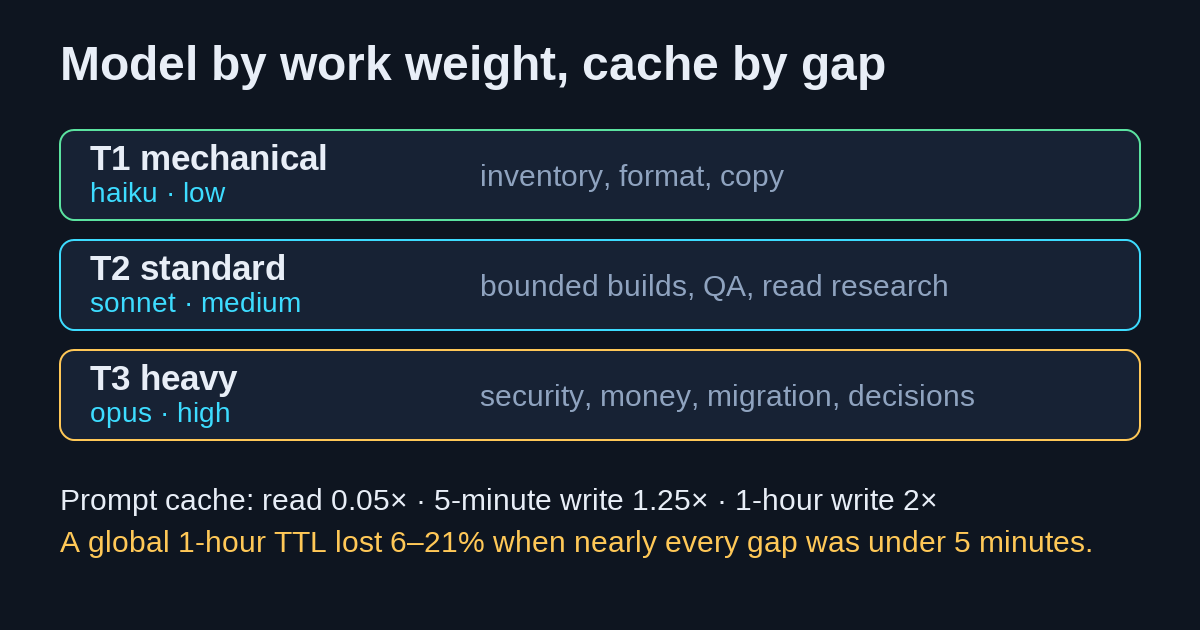
Rule one: the model follows the work weight
| Tier | Model and effort |
|---|---|
| T1 mechanical (inventory, format, copy, status checks) | haiku, low |
| T2 standard (bounded builds, QA, read-only research) | sonnet, medium |
| T3 heavy (security, money, data migration, architecture decisions) | opus, high |
From the router-model-agen skill.
Start at the lowest tier that is enough. Move up only if a task fails twice with the same brief or hits a T3 trigger. And the rule is enforced by a hook: an agent call that does not name a model is rejected, so it cannot be forgotten.
Rule two: the cache follows the gap, not the task length
A prompt cache stays warm only if the next call arrives before it expires. The costs differ:
- Reading from cache: 0.05x the input price.
- Writing a 5-minute cache: 1.25x.
- Writing a 1-hour cache: 2x.
A 1-hour cache only pays off if gaps over 5 minutes are common. I measured 615 real subagent runs with my own audit script: 99% of gaps were under 5 minutes. So setting one hour for every subagent loses 6 to 21 percent.
The rule: only an agent with a step that waits over 5 minutes (a long build, a full test run, a deploy) uses a dedicated one-hour-cache agent. Everything else keeps the default.
The limits of this claim
The 615 runs and the 6–21 percent come from an audit of my own setup on 2 November 2026. They are not a general benchmark and nobody else has repeated them. What is reusable is the method: measure the real gaps first, then choose the TTL.
Source: quoted from internal work notes (the router-model-agen and ttl-cache-subagen skills; TTL research note of 2 Nov 2026), not yet public. The 615 runs and 6–21 percent cannot be checked by readers yet.