We spent $291 building an AI agent. Here’s the one that refuses to spend your money.

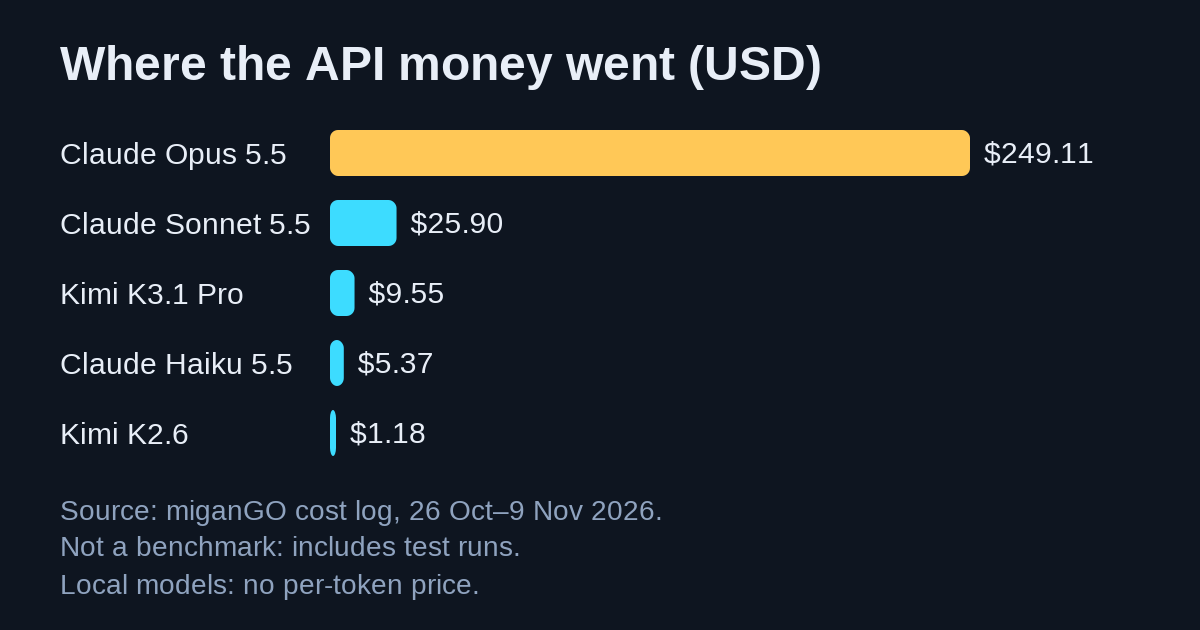
Between 26 October and 9 November 2026 we logged 627 runs of our own desktop agent, miganGO. Its cost log says those runs used about $291 of API credit, and $249 of that went to a single model, Claude Opus, including test and verification runs.
That number is the reason miganGO exists, and the reason we have open-sourced it under the MIT licence: github.com/fahmiwol/migango-agent.
| Model | Spent |
|---|---|
| Claude Opus 5.5 | $249.11 |
| Claude Sonnet 5.5 | $25.90 |
| Kimi K3.1 Pro | $9.55 |
| Claude Haiku 5.5 | $5.37 |
| Kimi K2.6 | $1.18 |
| qwen3.5:4b, qwen3:4b (home CPU) | $0.00 |
Not a benchmark: it includes test and verification runs. Local models have no per-token price. Total: $291.11.
The problem we wanted to solve
AI agents tend to assume a fast cloud model and an unlimited card. Most of us have neither. We have a laptop, maybe a cheap mini PC at home, and a monthly budget we would like to keep.
We read the documentation of other agents (opencode, Cursor, Claude Code, Codex, Hermes Agent, OpenClaw, Cline) and wrote down what each one does, with a source for every cell. The result is in COMPARISON.md in the repository, including the cells we could not confirm. We make no ranking claim here; read the table and judge for yourself. These are the three choices miganGO made:
- a hard, per-provider daily spend cap inside the agent, not an estimate and not an external gateway;
- a cloud fallback that asks first, per task, instead of switching automatically;
- an interface in Bahasa Indonesia.
What miganGO does
1. Local model first. The default route is Ollama on a CPU-only box at home (we use qwen3.5:4b on a mini PC, reached over WireGuard). There is no per-token bill because the model runs on your own machine; you still pay for the machine and its power.
2. It stops instead of switching. If the home box is unreachable, the run halts with one button: “Use a cloud model for this task.” One task, one click, the cheapest capable model, and a visible “fallback model” label on the answer.
3. A spend gate you can read as one line of math. Before every call the agent reserves the estimated cost under a file lock and proceeds only if
spent(p, today) + r ≤ cap(p)
where p is the provider and r is the reserved estimate. Default caps: $5 Anthropic, $3 Kimi, $3 Gemini, $10 RunPod, and 2 million tokens a day.
4. Tools are an intersection, not a vibe. A tool runs only if the owner, the built-in policy, the agent, the mode and the parent agent all allow it. Risky calls also need an exact, one-time approval that expires in 120 seconds.
5. Crashes don’t double-send. A recovery journal records side effects. After a crash, anything uncertain is held for you to inspect, never replayed.
What it is not (yet)
Honesty is cheaper than a bad review:
- Windows only today (it uses AppContainer and Job Objects).
- Built by one person with AI pair-programmers in 18 days: 514 commits and about 1,480 test cases.
- The project is community-driven from here: the author is focusing on other products. English UI strings, macOS and Linux support, a RAG module and an image adapter are all open issues.
The lesson we would share
Measure your own agent with your own agent. The table above is not a benchmark, since it includes deliberate failure tests, but it changed our roadmap in one afternoon: one model took about 86% of the spend. Default to local, cap the cloud, and make switching models a choice a human makes.
Star it, fork it, break it: github.com/fahmiwol/migango-agent
Data: miganGO cost log and run records, 26 Oct to 9 Nov 2026. Competitor facts: sources listed in COMPARISON.md, accessed 9 Nov 2026.